

BUSINESS INSIGHTS
How HVAC Contractors Can Get Found in ChatGPT
What HVAC companies should know about AI visibility—and how to strengthen the online signals that help customers and AI platforms discover, understand, and trust their business.
SearchSpotlight™ by Search-IDEALZ4U •
August 2026 • 11 - 13 minute read
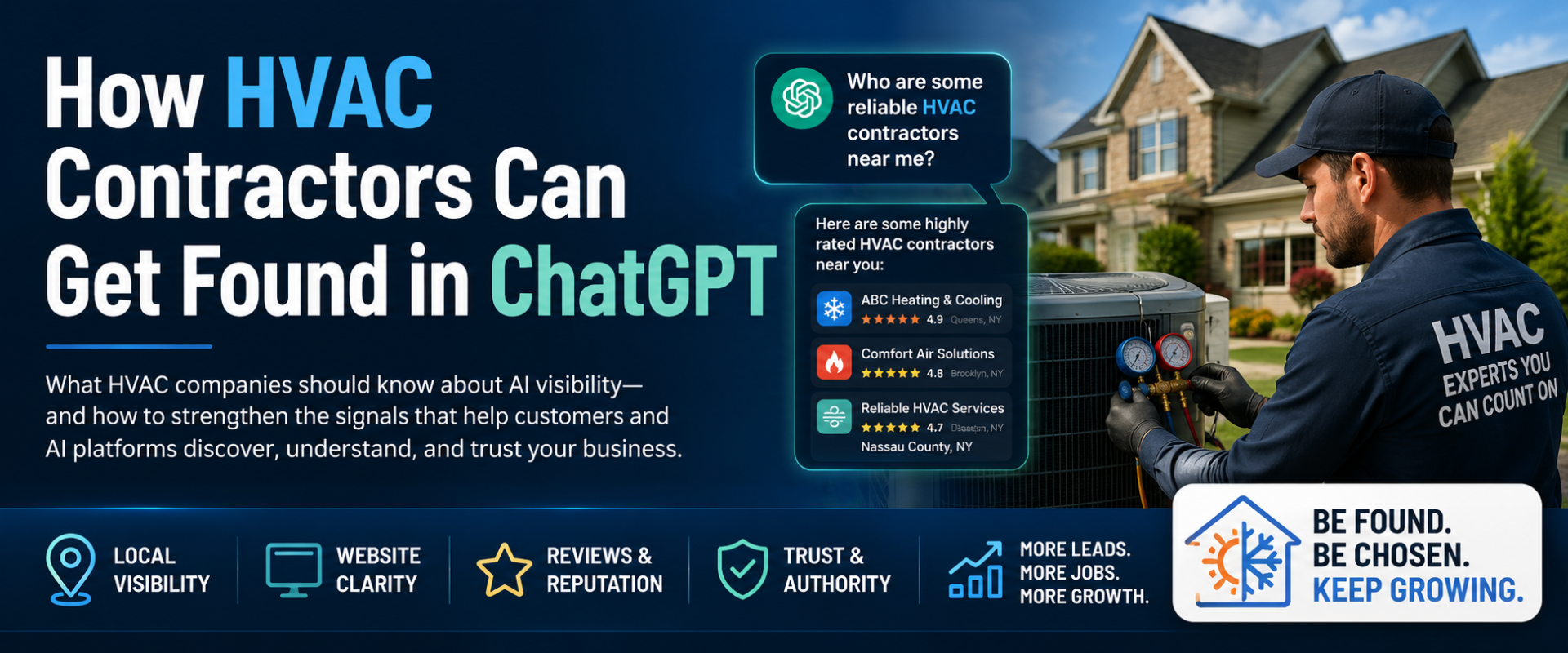
Table of Contents
- The Way Homeowners Search for HVAC Help Is Changing
- What Does “Getting Found in ChatGPT” Actually Mean?
- How AI Systems Understand an HVAC Company
- Local Search Signals Still Matter
- Your Website Needs to Explain More Than “Heating & Cooling”
- Make Your Service Area Clear
- Your Google Business Profile Matters
- Reviews Help Establish Real-World Trust
- Consistency Across the Web Matters
- Authority Goes Beyond Your Own Website
- Make Your Website Accessible to AI Search
- What AI Visibility Is Not
- An AI Visibility Checklist for HVAC Contractors
- Could ChatGPT Find Your HVAC Company?
- Curious How Visible Your HVAC Business Is?
- About SearchSpotlight™ by Search-IDEALZ4U
- References & Official Resources
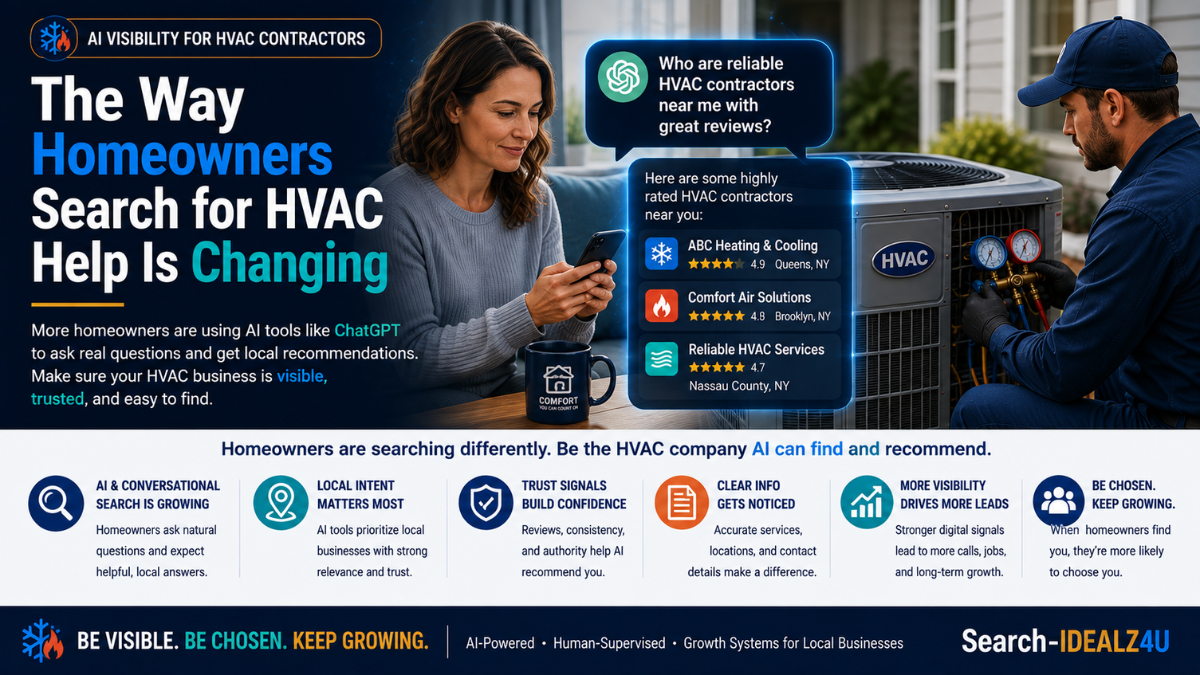
The Way Homeowners Search for HVAC Help Is Changing
For years, homeowners looking for an HVAC contractor followed a familiar process.
They might search Google for:
“HVAC contractor near me”
“AC repair in Queens”
“furnace replacement near me”
“best HVAC company in Bergen County”
Those searches still matter.
But another type of search is becoming increasingly important: conversational AI search.
Instead of entering a few keywords, a homeowner can now ask questions such as:
“Who are some reliable HVAC contractors near me?”
“Find companies that install heat pumps in my area.”
“Which HVAC companies near me have strong customer reviews?”
“I need to replace my central air system. What local contractors should I consider?”
“Who provides emergency furnace repair near me?”
ChatGPT can search the web when current information is useful and provide answers that include links to web sources.
That creates another place where local businesses may potentially be discovered.
For HVAC contractors, the question is no longer only:
Can customers find us on Google?
It is increasingly also:
Can AI systems understand who we are, what we do, where we work, and why someone might consider our company?
That is where AI visibility begins.
What Does “Getting Found in ChatGPT” Actually Mean?
Getting found in ChatGPT does not mean there is a special business directory where HVAC companies can simply submit their information and automatically appear in recommendations.
And there is no legitimate way to guarantee that ChatGPT will recommend a particular HVAC company for a particular question.
AI visibility is better understood as making your business clear, credible, accessible, and consistently represented across the web.
When someone asks an AI system about a local business or service, the system may need to understand several basic facts:
- Who is this company?
- What services does it provide?
- Where does it provide those services?
- Is the information current?
- Are there credible sources supporting those facts?
- Is the business represented consistently elsewhere online?
- Is there enough useful information to understand whether the business is relevant to the user's request?
An HVAC contractor with a thin website, vague service descriptions, inconsistent business information, and little third-party presence gives search systems less useful information to work with.
A contractor with a detailed website, accurate local information, clearly defined services, legitimate customer reviews, and consistent references across the web provides a much clearer picture.
AI visibility begins with clarity.
How AI Systems Understand an HVAC Company
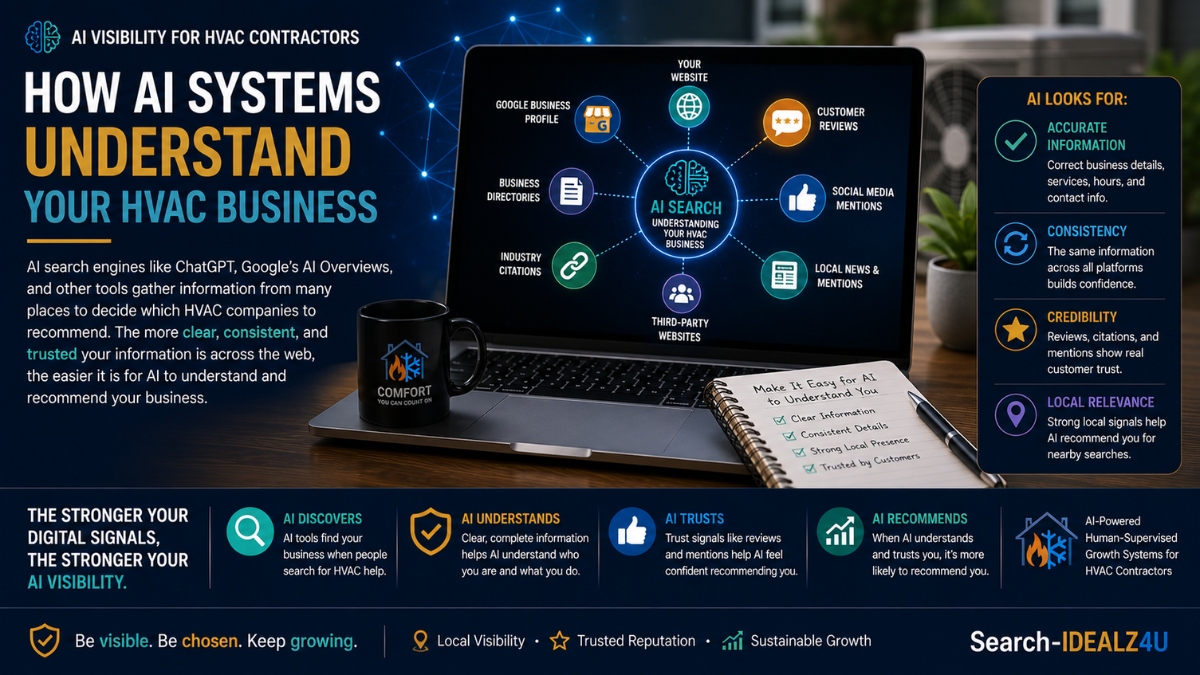
Think about your online presence as a collection of evidence about your business.
Your website may say one thing.
Your Google Business Profile may provide another set of details.
Business directories may contain your company information.
Customers may describe their experiences in reviews.
Manufacturer or dealer directories may list your company.
Trade organizations, local publications, chambers of commerce, community
organizations, news articles, and other independent websites may mention your business.
Together, those sources can help establish an understandable online identity.
For an HVAC contractor, that identity should answer questions such as:
What is the exact business name?
Where is the company based?
What areas does it actually serve?
Does it provide residential HVAC, commercial HVAC, or both?
Does it repair air-conditioning systems?
Does it replace furnaces?
Does it install heat pumps?
Does it service boilers?
Does it install ductless mini-splits?
Does it provide emergency service?
Does it offer maintenance agreements?
How can customers contact the company?
If these answers are difficult for a human visitor to determine, they may also be difficult for search and AI systems to interpret.
Local Search Signals Still Matter
AI visibility should not be treated as a replacement for traditional local search optimization.
For an HVAC company, the foundations of strong local visibility remain important:
- An accurate Google Business Profile
- A useful, well-structured website
- Clear service descriptions
- Accurate business information
- Defined service areas
- Legitimate customer reviews
- Relevant business listings
- Local references and mentions
- Helpful content that demonstrates expertise
- Consistent information across online sources
Google itself says its local results are primarily influenced by relevance, distance, and prominence.
That does not mean ChatGPT uses Google's local-ranking formula.
It means something more practical:
The work required to establish a strong, trustworthy local business presence continues to matter even as customers adopt new ways of searching.
The objective should therefore not be to abandon SEO for “AI optimization.”
A better approach is to create a stronger overall digital presence that can support visibility across traditional search, maps, websites, and emerging AI discovery channels.
Your Website Needs to Explain More Than “Heating & Cooling”
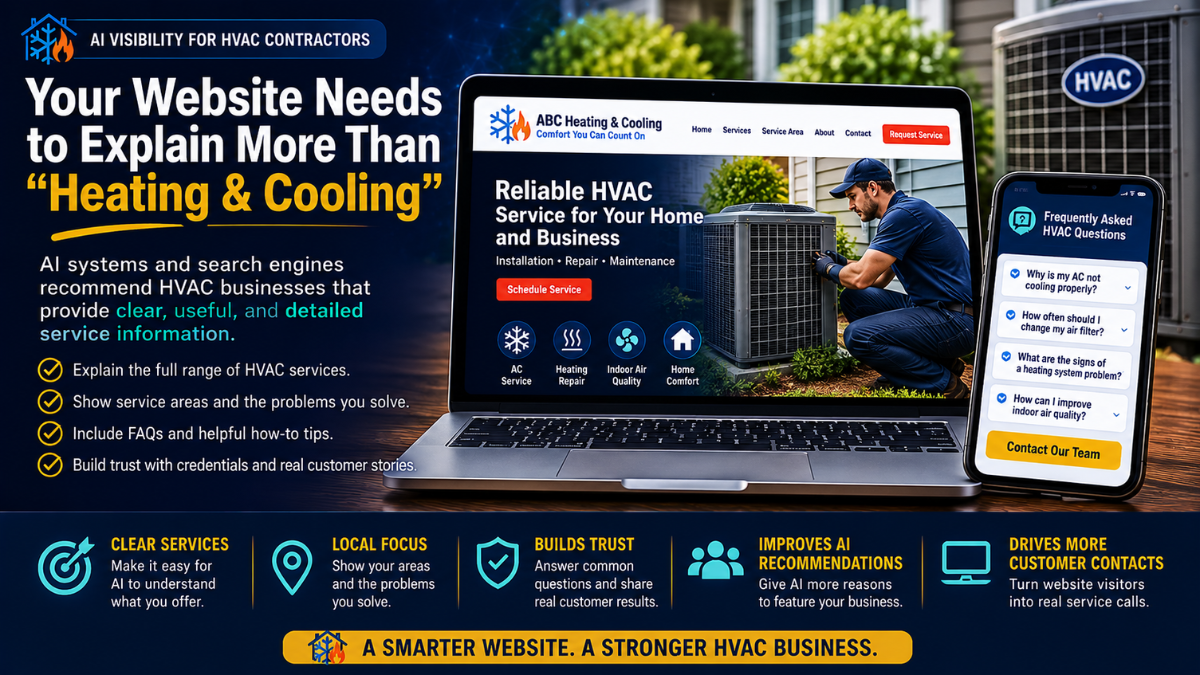
One of the most common problems with HVAC websites is that they assume visitors already understand the business.
A homepage may say:
“Your Trusted Heating & Cooling Experts.”
That sounds professional.
But what does the company actually do?
Compare that with a website that clearly explains that the company provides:
- Central air-conditioning repair
- AC system replacement
- Furnace repair
- Furnace installation
- Heat pump installation and service
- Ductless mini-split installation
- Boiler repair and replacement
- Indoor air quality solutions
- HVAC maintenance
- Thermostat installation
- Emergency HVAC service
- Residential HVAC
- Commercial HVAC
Not every contractor provides every service above.
That is precisely the point.
Your website should clearly describe the services your company actually provides.
If you specialize in heat pumps, explain heat pumps.
If you do not work on boilers, do not create boiler pages simply because competitors have them.
If your company primarily serves residential customers, make that clear.
If you have a significant commercial HVAC division, explain what kinds of commercial properties and systems you service.
The objective is not to stuff pages with HVAC keywords.
The objective is to remove ambiguity.
Make Your Service Area Clear
HVAC is inherently local.
A homeowner in Queens probably does not need an HVAC contractor based three states away.
Location therefore needs to be communicated accurately.
Suppose an HVAC company is based in Queens and regularly serves:
- Queens
- Brooklyn
- Nassau County
The website should make that relationship understandable.
It could go further by identifying legitimate communities the company regularly serves and providing genuinely useful information for customers in those locations.
What it should not do is generate hundreds of nearly identical location pages merely to create the appearance of serving every city in a region.
Accuracy matters.
Google's guidance for service-area businesses also emphasizes specifying actual service areas rather than representing a business inaccurately.
For HVAC contractors that travel to customers, Google Business Profile allows service areas to be defined by cities, postal codes, and other supported geographic areas.
Your website, Google Business Profile, business listings, and other important profiles should tell a reasonably consistent geographic story.
Your Google Business Profile Matters
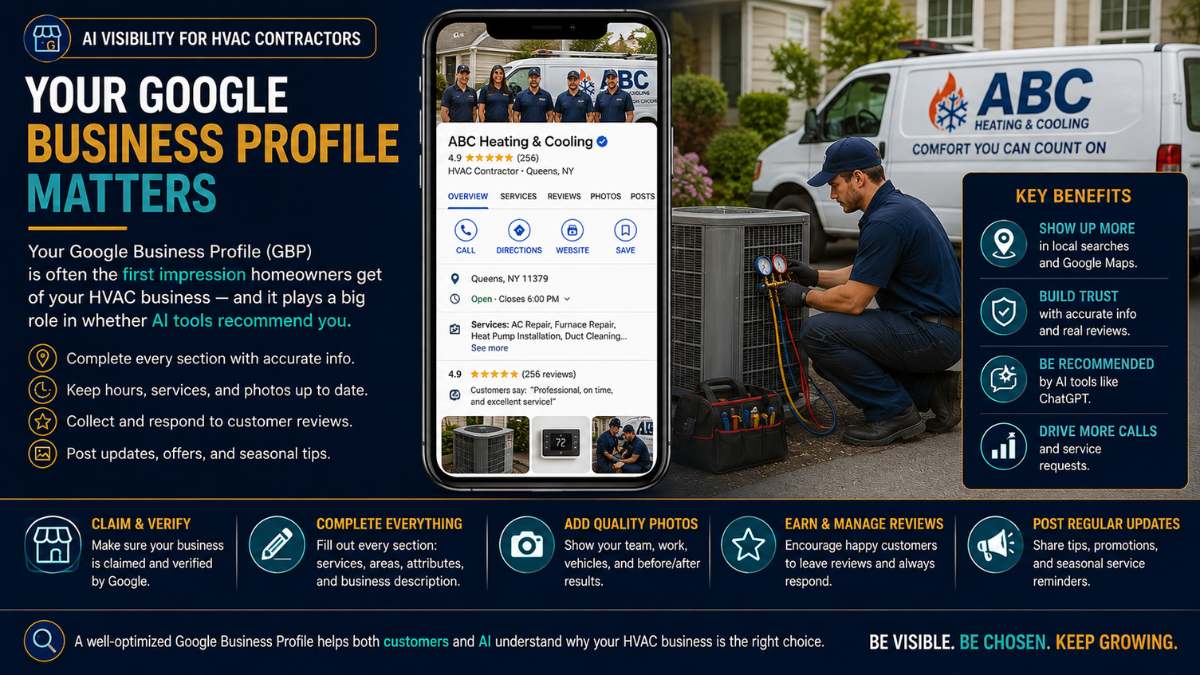
For a local HVAC contractor, the Google Business Profile remains one of the most important pieces of the company's online presence.
A complete profile can communicate information including:
- Business name
- Business category
- Phone number
- Website
- Business hours
- Service area
- Photos
- Services
- Customer reviews
Google specifically recommends keeping business information complete and accurate so customers can understand what a company does and where it operates.
For service businesses, there is another particularly relevant detail.
When customers leave reviews, Google may ask them what type of work the company performed. Those job types can be informed by the business's service list, website, standard services for the business type, and other authoritative sources.
That is another reason an HVAC contractor should accurately describe its actual services instead of leaving its profile and website incomplete.
Your Google Business Profile should not exist separately from your website strategy.
The two should reinforce each other.
Reviews Help Establish Real-World Trust
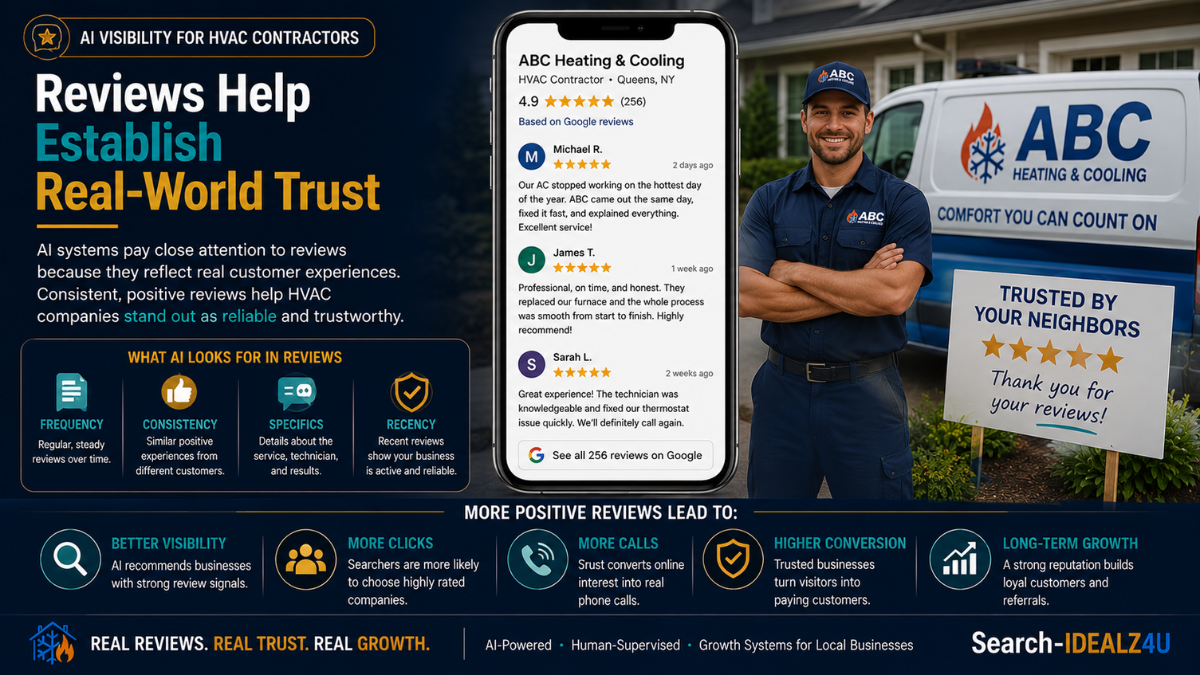
Imagine two HVAC companies.
Company A
Has a website claiming excellent service but very little customer feedback.
Company B
Has customers describing actual experiences such as:
- AC repair
- Furnace replacement
- Heat pump installation
- Emergency service
- Professional technicians
- Responsiveness
- Communication
- Quality of workmanship
Which company gives a prospective customer more information to evaluate?
Usually, Company B.
Reviews can provide something the company's own marketing cannot:
the customer's perspective.
For HVAC contractors, authentic reviews can help prospective customers understand what kinds of work the company performs and what previous customers experienced.
Google says reviews can help businesses stand out and provide useful information to potential customers.
But review generation needs to remain ethical.
Do not buy reviews.
Do not create fake customer accounts.
Do not offer incentives in exchange for positive reviews.
Do not pressure customers to write particular words.
Instead, make it easy for genuine customers to provide honest feedback.
A healthy review strategy is about building an authentic record of customer experiences over time.
Consistency Across the Web Matters
Suppose your website says:
ABC Heating & Cooling LLC
Your Google Business Profile says:
ABC HVAC
One directory lists:
ABC Heating
Another has an old phone number.
A third links to an outdated website.
Your Facebook page shows different business hours.
And an old directory lists a location you left three years ago.
Even if each inconsistency seems minor, collectively they create unnecessary confusion.
Businesses naturally change over time. Phone numbers change. Offices move. Websites are redesigned. Services expand.
The problem occurs when old information remains scattered around the web.
Periodically review important sources for:
- Business name
- Website
- Phone number
- Address, when publicly applicable
- Service area
- Business category
- Hours
- Core services
Consistency does not mean every website must contain identical paragraphs.
It means the fundamental facts about your company should not contradict one another.
Authority Goes Beyond Your Own Website
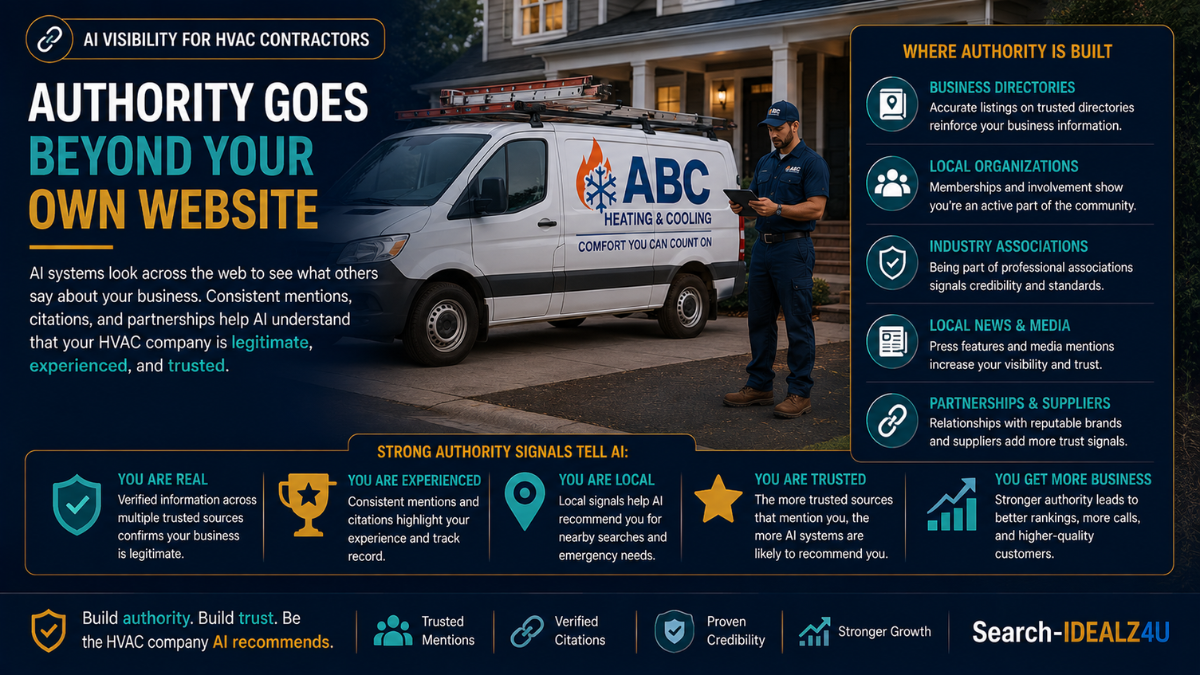
Every company can describe itself as experienced, professional, and trustworthy.
Independent sources are different.
An HVAC contractor might legitimately appear on:
- Manufacturer or authorized-dealer directories
- Trade association websites
- Chamber of commerce directories
- Better Business Bureau profiles
- Local business organizations
- Community organizations
- Local news websites
- Industry publications
- Supplier or partner websites
- Professional licensing resources, where applicable
- Local business features and editorial profiles
Not every HVAC contractor will have all of these.
And simply creating large numbers of low-quality directory listings is not the objective.
The goal is to build a legitimate online footprint that reflects the company's real-world presence.
For example, if an HVAC company has served a community for 25 years, employs certified technicians, participates in community programs, has manufacturer certifications, or has reached an important business milestone, those may be meaningful facts worth documenting online.
This is also one reason independent editorial coverage can be useful.
A well-researched business profile can explain a company's history, people, services, community connection, and differentiators in greater depth than a basic directory listing.
The emphasis should remain on real information and genuine authority—not manufactured publicity.
Make Your Website Accessible to AI Search
There is another part of AI visibility that businesses can easily overlook:
Can AI search systems access your website at all?
OpenAI states that public websites can appear in ChatGPT search and provides guidance for website owners who want their content to be discoverable and cited.
For content to be eligible for inclusion in ChatGPT search summaries and snippets, website owners should ensure they are not blocking OAI-SearchBot.
That makes technical accessibility part of the conversation.
An HVAC company could create excellent service pages, useful FAQs, detailed service-area information, and helpful educational content—but unnecessary crawler restrictions could reduce the ability of certain search systems to access that information.
This is one reason AI visibility should involve both content strategy and technical review.
What AI Visibility Is Not
As interest in AI search grows, so do exaggerated claims about “ranking #1 in ChatGPT.”
HVAC business owners should be cautious.
AI visibility is not a guaranteed ChatGPT ranking.
No legitimate agency can promise that your company will always be recommended for a particular ChatGPT question.
It is not a secret submission service.
There is no magic form that guarantees your HVAC company will suddenly become ChatGPT's preferred recommendation.
It is not keyword stuffing.
Repeating “best HVAC contractor near me” dozens of times does not make a page more useful.
It is not creating hundreds of low-quality AI pages.
Mass-producing nearly identical city and service pages may create more URLs without creating more value.
It is not buying fake reviews.
Fake reputation signals undermine trust and can violate platform policies.
It is not abandoning Google.
Customers still use Google Search, Google Maps, websites, referrals, social platforms, directories, and other channels.
AI visibility should complement a strong digital marketing foundation—not replace it.
What AI Visibility Is Not
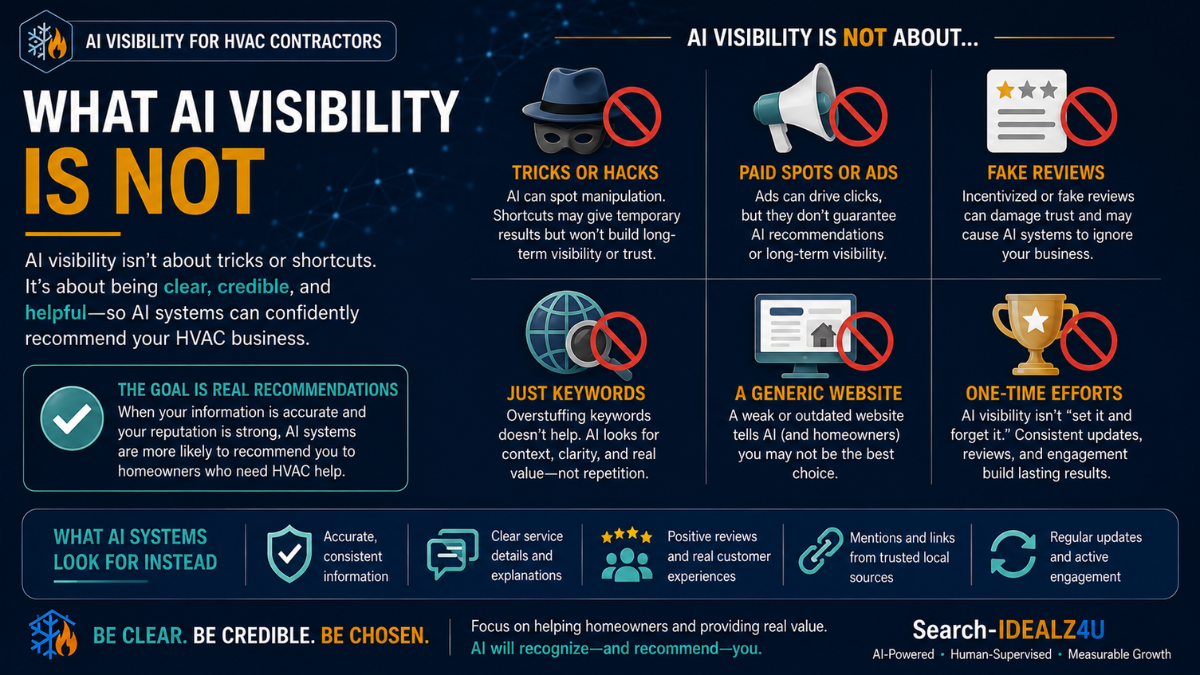
As interest in AI search grows, so do exaggerated claims about “ranking #1 in ChatGPT.”
HVAC business owners should be cautious.
AI visibility is not a guaranteed ChatGPT ranking.
No legitimate agency can promise that your company will always be recommended for a particular ChatGPT question.
It is not a secret submission service.
There is no magic form that guarantees your HVAC company will suddenly become ChatGPT's preferred recommendation.
It is not keyword stuffing.
Repeating “best HVAC contractor near me” dozens of times does not make a page more useful.
It is not creating hundreds of low-quality AI pages.
Mass-producing nearly identical city and service pages may create more URLs without creating more value.
It is not buying fake reviews.
Fake reputation signals undermine trust and can violate platform policies.
It is not abandoning Google.
Customers still use Google Search, Google Maps, websites, referrals, social platforms, directories, and other channels.
AI visibility should complement a strong digital marketing foundation—not replace it.
An AI Visibility Checklist for HVAC Contractors
Ask yourself the following questions.
Business Identity
□ Is our business name represented consistently online?
□ Is our current phone number easy to find?
□ Does our website clearly identify our company?
Services
□ Do we clearly explain our primary HVAC services?
□ Can someone easily determine whether we handle AC repair?
□ Furnace replacement?
□ Heat pumps?
□ Ductless systems?
□ Boilers, if applicable?
□ Emergency HVAC services, if offered?
Location
□ Does our website clearly explain where we operate?
□ Are our Google Business Profile service areas accurate?
□ Are outdated locations removed from important profiles?
Reputation
□ Are we consistently receiving genuine customer reviews?
□ Do we respond professionally when appropriate?
□ Do reviews reflect actual customer experiences?
Website
□ Does each important service have enough information for a homeowner to understand it?
□ Does our website answer common customer questions?
□ Are our contact options obvious?
□ Is important business information current?
Authority
□ Are legitimate certifications and affiliations documented?
□ Are manufacturer relationships accurately represented?
□ Are there credible independent references to our company?
AI Accessibility
□ Is our website technically accessible to search engines?
□ Have we checked whether relevant AI search crawlers are unintentionally blocked?
If several of those questions produce a “No” or “I'm not sure,” you may have visibility gaps worth investigating.
Could ChatGPT Find Your HVAC Company?
Here is a simple exercise.
Open ChatGPT and try questions that a real homeowner might ask.
For example:
“Find HVAC contractors that install heat pumps in [your city].”
“Who provides furnace repair near [your neighborhood]?”
“What HVAC companies serve [your county]?”
“Find highly rated air-conditioning contractors near me.”
Then examine the results.
Does your company appear?
If it does, is the information accurate?
Does ChatGPT understand what services you provide?
Does it associate you with the correct geographic area?
Are competitors appearing where you are not?
What sources seem to be helping those businesses establish their presence?
Do not treat one search as a definitive ranking test.
AI-generated responses can vary based on the question, context, available sources, location, and other factors.
Instead, use these searches diagnostically.
They can help reveal a broader question:
Does the web contain enough clear, consistent, credible information about your HVAC company for modern search systems to understand it?
Curious How Visible Your HVAC Business Is?
Your HVAC company may already have a website.
You may already have a Google Business Profile.
You may already be collecting reviews.
But that does not necessarily mean all of those pieces are working together effectively.
Search-IDEALZ4U offers a FREE Personalized Growth Plan designed to help local businesses identify potential gaps and growth opportunities across their digital presence.
The process looks at areas that may include:
- Local search visibility
- Google Business Profile
- Website conversion opportunities
- Reviews and reputation
- AI visibility
- Lead capture and follow-up
- Advertising opportunities
- Analytics and tracking
It is to identify what appears to be missing, what may deserve attention first, and which opportunities could make sense for the individual business.
Get Your FREE Personalized Growth Plan
Click the Free Growth Plan button and complete the short Discovery Chat.
Your information is used to generate a personalized Growth Plan based on your business, goals, and current marketing situation.
AI-Powered. Human-Supervised. Built for Local Business Growth.
About SearchSpotlight™
SearchSpotlight™ by Search-IDEALZ4U publishes practical educational insights to help local businesses understand how AI search, local visibility, online reputation, and digital marketing are changing.
Our goal is to make these topics clear and useful so business owners can make better-informed marketing decisions.
SearchSpotlight™ also publishes Business Spotlights and Community Spotlights highlighting businesses, organizations, people, and stories worth discovering.
Search-IDEALZ4U is an AI-powered, human-supervised digital marketing agency serving local businesses in New York, New Jersey, Connecticut, and throughout the United States.
References & Official Resources
Official information explaining how ChatGPT can search the web and provide responses with links to relevant web sources.
OpenAI — Publishers and Developers FAQ
Official guidance explaining how public websites can appear in ChatGPT search, including information about OAI-SearchBot and website accessibility.
Google Business Profile — Get Started
Official Google guidance covering Business Profile information, customer interaction, reviews, photos, services, and local visibility.
Manage Your Service Areas for Service-Area & Hybrid Businesses
Official guidance explaining how service-area and hybrid businesses can define and manage the geographic areas they serve.
Tips to Improve Your Local Ranking on Google
Official information explaining Google's primary local search factors, including relevance, distance, and prominence.
Manage Your Services on Your Business Profile
Official guidance for adding and managing the services a business provides on its Google Business Profile.
About Reviews for Service Businesses
Official information explaining how reviews work for service businesses, including how customers may identify the type of service or job performed.
Official guidance for requesting genuine customer reviews and Google's policies against incentivized or misleading reviews.
SearchSpotlight™ is the official publication of Search-IDEALZ4U, celebrating local businesses, sharing practical marketing insights, and strengthening communities.
About